Example
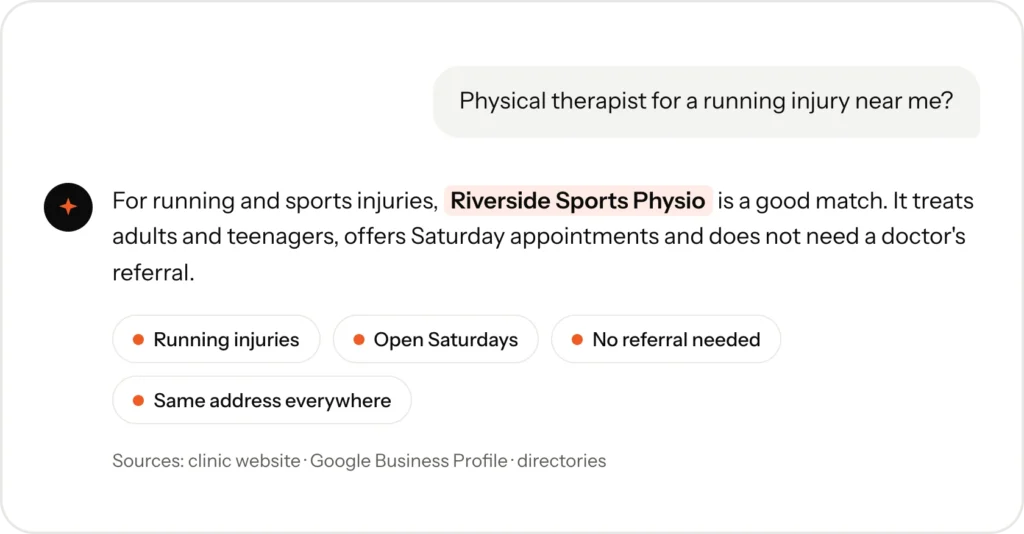
Picture a physical therapy clinic that treats running and sports injuries. Call the owner Priya. One morning a new patient mentions, almost in passing, that she asked ChatGPT to suggest a physical therapist for her sore knee. It named two other clinics. That evening Priya asks the same question, wondering how a clinic gets recommended by ChatGPT at all.
Her clinic does appear in one answer.
It lists the address she moved out of two years ago.
There is no switch she can flip to change that. But there is a reason the AI got her wrong, and that reason can be fixed.
How does ChatGPT decide which businesses to mention?
ChatGPT, Gemini and Google’s AI answers build their replies from what they can read across the web. For a local business, that usually means your website, your Google Business Profile, directories and reviews.
ChatGPT can also search the web live when a question needs current information. OpenAI explains in its overview of OpenAI crawlers that a crawler called OAI-SearchBot finds websites for those search answers. A crawler is a program that visits pages and reads them. OpenAI says sites that block OAI-SearchBot will not be shown in ChatGPT search answers.
So the AI was not judging Priya’s work. It was assembling the facts it could find, and one of those facts was out of date.
Key point: AI tools repeat what they can read. Your job is to make the right facts easy to read.
Which raised the real question: what else was it reading?
Why might an AI tool skip your business or get it wrong?
When Priya looked closely, her clinic had all four of the usual problems.
- The facts were missing. Her homepage said “Move better. Live better.” It never said, in plain words, that she treats sports injuries in her town.
- The facts were in the wrong format. Her opening hours lived inside an image. AI tools read text, so to them the hours did not exist.
- The facts did not match. Two directories still showed her old address. Her profile showed the new one. Faced with conflicting details, an AI is less likely to mention you, or may repeat the wrong version.
- Nothing answered the questions patients ask. No page explained whether she sees patients without a doctor’s referral or how long a first visit takes.
None of these is a technical failure. Each one is a fact that was missing, hidden or contradicted. That makes the fixes simpler than most owners expect.
How do you get your business recommended by ChatGPT more often?
There is no switch, but there is a clear order of work. Each step removes a reason to skip you.
Write your key facts as plain sentences
State what you do, where and for whom, in words an AI can quote. Compare “Move better. Live better.” with “Physical therapy for running and sports injuries in our town, for adults and teenagers.” The first is a slogan. The second is a fact. Clear facts get repeated. Vague slogans get skipped.
Give each service its own page
A page about knee pain from running answers that search far better than a homepage that lists ten treatments. Each page should say what the service is, who it helps and how to book.
Answer the questions people actually ask
Priya’s front desk heard the same five questions every week. Write those down, then answer each one at the top of a page or in an FAQ. AI tools often answer with a short quote from pages like these, so lead with the answer, then explain.
Make your details match everywhere
Your name, address, phone number and hours should be identical on your website, your Google Business Profile and every directory. One out-of-date listing can be enough to confuse an AI tool, as Priya found out.
Add structured data
Structured data is a set of labels in your page code that tells machines what your services, location and reviews are. Visitors never see it. Search engines and AI tools can read it.
Check that you are not blocking AI search crawlers
Your website has a small file called robots.txt that tells crawlers which pages they may visit. It is worth checking, along with any security tool on your site, that nothing blocks crawlers you want. If OAI-SearchBot is blocked, OpenAI says your site will not be shown in ChatGPT search answers.
Key point: Most fixes are about saying the same plain facts, the same way, everywhere.
What did Priya change?
Her fixes took a few weeks, and none of them were technical magic.
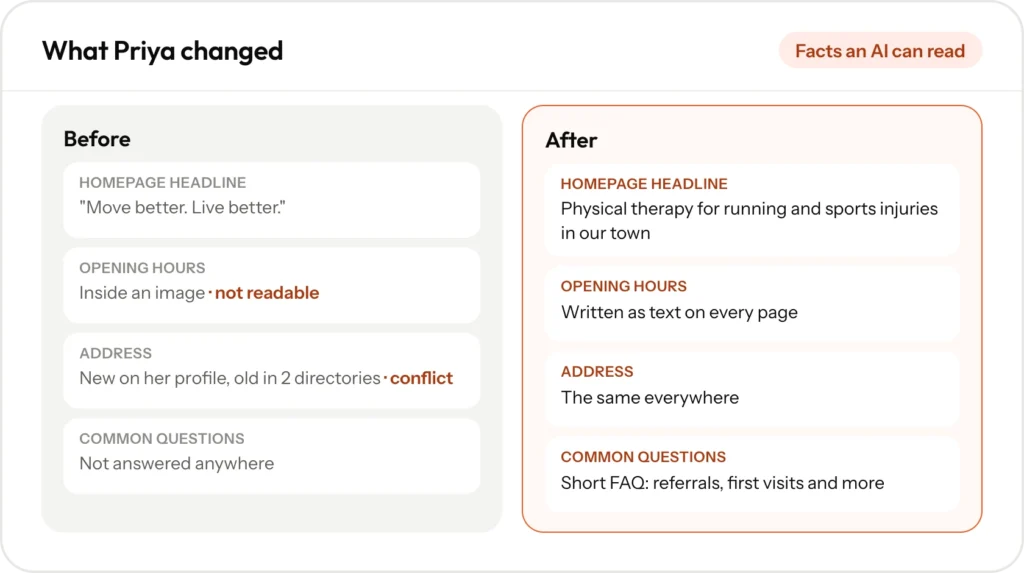
Her homepage headline now says what she does and where. The opening hours are written as text. Each main service has its own page: running injuries, sports rehab and post-surgery recovery. A short FAQ answers the five questions her front desk hears most, including whether a referral is needed.
Then came the dull but important part. She updated the old address in the two directories that still had it, and checked that her Google Business Profile matched her website word for word. Structured data went onto the key pages.
Example
A few weeks later, Priya asks ChatGPT the same question about a sore knee.
Will it now recommend her to everyone? No one can promise that. AI answers change from one question to the next, and other clinics are doing the same work. What has changed is that the AI no longer has a reason to send patients to an empty building, and it has plain sentences to use when her clinic is a good match.
How can you check what AI tools say about you?
Do what Priya did: ask them. Use the questions your customers would ask, such as “best physical therapist for a running injury near me”, in ChatGPT, Gemini and Google’s AI answers. Write down what each one says about you and your competitors. Answers vary, so ask a few versions of each question.
Then repeat the same questions after you make changes. That before-and-after check is the most honest measure available, because nobody outside the AI companies can see exactly how they choose.
Is this different from SEO?
It builds on SEO. Good local SEO already asks for clear pages, a complete Google Business Profile and consistent listings. AI search optimization puts more weight on plain facts, structured data and answer-first pages. If you are working on your map listing, our guide on how to get your business on Google Maps covers the overlap.
AI search optimization is included in every Presence Build, and your Presence Scorecard records what AI tools say about you before we start. Read more about our AI search optimization or see what we build for healthcare practices. Prices are on our pricing page. You can also book a free 30-minute call, and we will tell you honestly what we see.
Frequently asked questions
No. No one controls what AI tools recommend. The work removes the reasons an AI would overlook or misread your business.
Start with ChatGPT, Gemini and Google’s AI answers. The same clear facts help other AI tools too.
Not always. If your current site is easy to edit, you can often add clear facts, service pages and FAQs to it. A site that hides key details in images or scripts usually needs more work.
Record what AI tools say about you before you start, then ask the same questions after the changes and compare the two.
Yes. It is included in every Presence Build, with an AI search baseline recorded in your Presence Scorecard first.